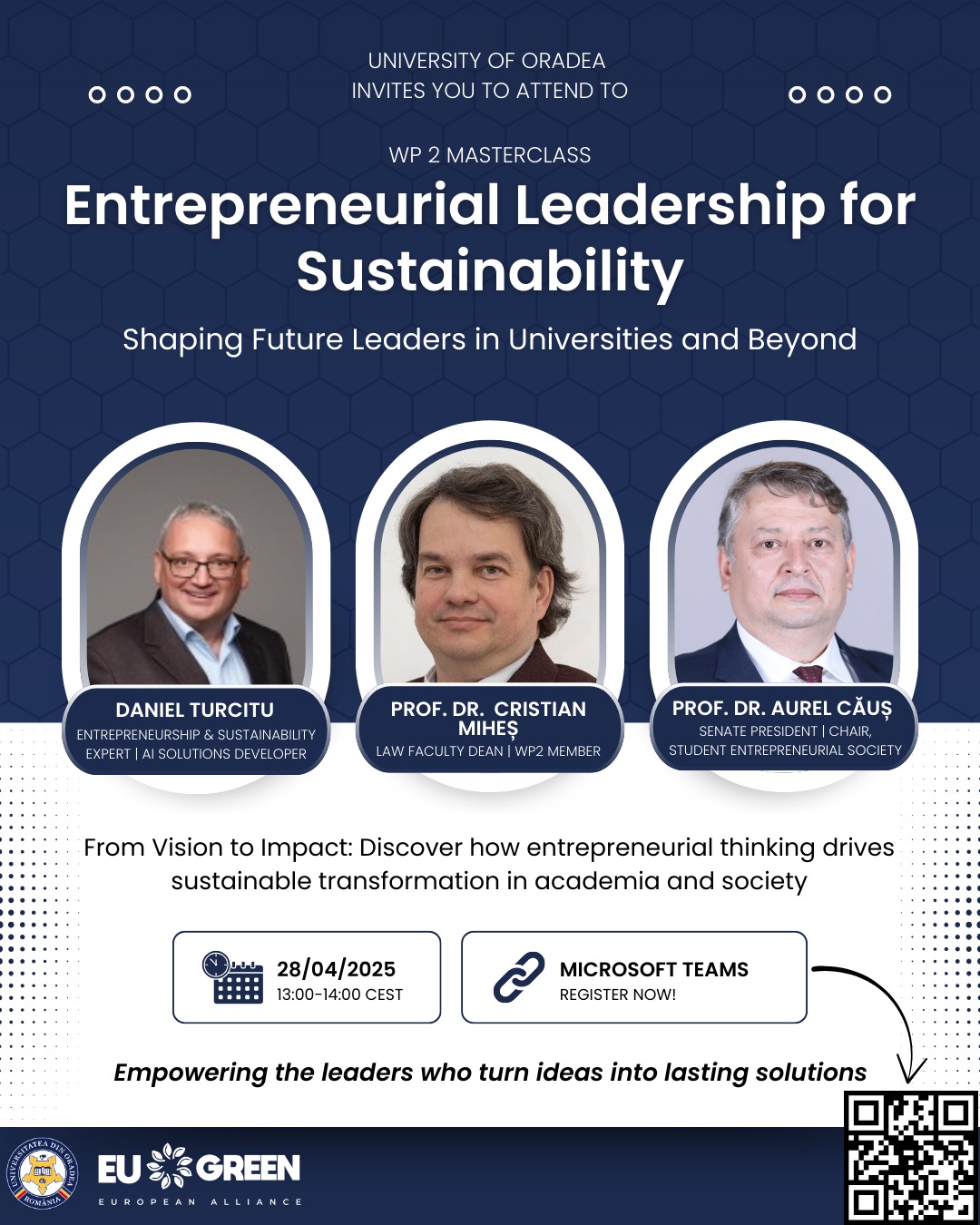

AI tools are already in our classrooms — often before we have decided what we want them to do there. This Masterclass gives teaching staff a working command of generative AI in higher education, built around three questions: which tools, which strategies, and what do we conclude?
Participants first build a functional mental model of how large language models actually behave, then examine where that behaviour helps or harms specific teaching tasks — preparation, in-class work, assessment and administration. Live demonstrations show what the technology does and does not do, and where its failure modes appear. The session closes with some legal and institutional framing (EU AI Act, data protection) and a structured reflection in which each participant defines one concrete change to their own teaching.
By the end of the session, participants will be able to:
– describe how generative AI systems produce output, and use that understanding to predict where they fail;
– identify and name recurring failure modes in AI-supported teaching work;
– match AI tools to specific teaching tasks using a four-level framework, from single prompts to structured workflows;
– locate their own practice within the UNESCO AI Competency Framework for Teachers (2024);
– formulate one specific, implementable commitment for their own teaching.
The session is open to teaching staff across all disciplines and requires no prior technical knowledge. All materials are released as Open Educational Resources under CC BY 4.0.
How can science education help address today’s sustainability challenges? This MasterClass presents the main research lines and educational experiences developed by our group, and related initiatives focused on sustainability, emotions and science education. Through examples involving primary school pupils and pre-service teachers, the session will explore how ecological literacy, biodiversity perception, emotions, misconceptions and sustainability competences influence science learning and environmental awareness. The MasterClass will also showcase innovative educational experiences based on active and experiential methodologies, including school gardens, gamified geology, biodiversity activities and inquiry-based science workshops. The session aims to reflect on the need for a more meaningful, emotionally connected and transformative science education capable of linking scientific knowledge with responsible action and sustainability.
Speakers: Prof. Isaac Corbacho-Cuello & Prof. Jesús Sánchez-Martín. University of Extremadura.
This EU GREEN Masterclass, organised by the University of Oradea, will explore how student voices can actively contribute to transforming universities into more sustainable, inclusive, and participatory academic environments. The session will focus on the role of student leadership, participatory governance, and meaningful engagement in shaping institutional strategies that respond to current social and environmental challenges.
Participants will reflect on how student participation can strengthen sustainability initiatives and democratic processes within higher education institutions. The masterclass will feature contributions from EdD. Carlton James Fitzgerald, Associate Professor at New England College (USA); Prof. Alin Ștefănuț, Chief School Inspector at the Bihor County School Inspectorate; and Raluca Lezeu, President of the Oradea Students’ Union (USO), offering diverse perspectives on student leadership and engagement in education.
This EU GREEN masterclass will present the framework of faculty development in Italy and highlight the teacher training and teaching incentive model developed at the University of Parma over the past two years. The session will explore how universities can support innovative teaching practices and professional development for academic staff, while fostering a culture of collaboration and continuous improvement in higher education.
The event will include a round table discussion with key representatives from the University of Parma: Prof. Simone Baglioni, Vice-Rector for Teaching; Prof. Maja Antonietti, Delegate for Innovative Teaching; Dr. Cristina Castracani, representing the Learning by Game Design group, which promotes interdisciplinary and participatory teaching approaches; and Dr. Roberta Bertoli, representing the C.A.R.E. group (Community, Educational Support, Relationships, and Professional Development), a mentoring initiative designed to strengthen peer support and professional growth among teachers.
Join us for this thought-provoking EU GREEN Masterclass led by Dr. Matteo Cattaneo (University of Gävle), which invites participants to reimagine education through the lens of attention. Moving beyond traditional content delivery, the session explores how teaching can cultivate spaces of care, inquiry, and meaningful human encounter.
The masterclass introduces the concept of “educating the gaze” and the Community of Inquiry as tools to slow down, pay attention to the overlooked, and promote deep listening and shared reflection. Drawing on the insights of critical thinkers, Dr. Cattaneo frames teaching as a way of mediating worlds and opening question-driven learning paths where students become active authors of what matters to them — and of themselves.
This EU GREEN Masterclass will explore the essential relationship between education and citizenship in the context of today’s rapidly evolving global and technological landscape. Delivered by Prof. Luís Sebastião (University of Évora) and Prof. Maria Luísa Branco (University of Beira Interior), both members of the Centre for Research in Education and Psychology at the University of Évora (CIEP-UE), the session will address how citizenship education remains a cornerstone of human development and democratic societies.
Grounded in classical reflection and contemporary challenges, the session will examine two key theses: that cosmopolitan citizenship must be shaped with sensitivity to local histories and cultures, and that the challenges posed by digitalisation, globalisation, and artificial intelligence can serve as opportunities to reconceptualise citizenship education. Participants will be invited to reflect on how civic participation is being redefined, and how education can respond to these changes while safeguarding democratic values.
How can urban and rural communities actively shape their own green spaces? This EU GREEN Masterclass, led by Dr. Małgorzata Świąder from the Wrocław University of Environmental and Life Sciences, will offer insights into participatory spatial planning, with a special focus on the development of community gardens. As the 2024 Climate Person of the Year (Young Scientist category) in Poland, Dr. Świąder brings expertise in environmental indicators and sustainable planning practices.
Participants will explore what defines a community garden, the various types and purposes they serve, and the principles behind their successful creation. Through inspiring examples from Europe, Poland, and Wrocław — including student-led projects at UPWr — the session will highlight how citizen participation can shape inclusive, sustainable, and vibrant public spaces. Practical tools for fostering community engagement and participatory design will also be shared.
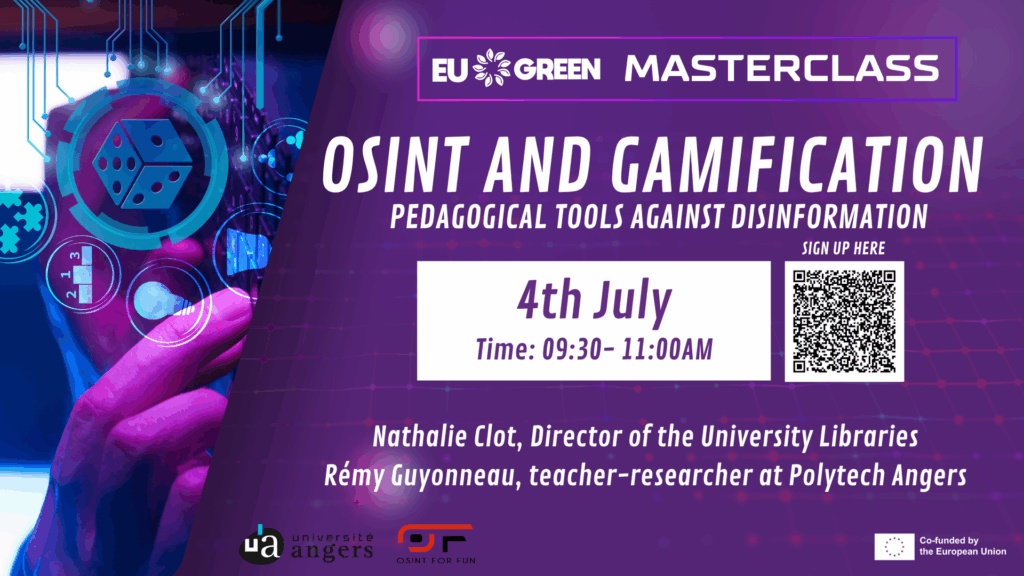
OSINT4FUN is an educational initiative launched in late 2023 by, among others, members of the University of Angers. It regroups:
- Educational Resources: OSINT4FUN offers free, Creative Commons-licensed materials such as tutorials, thematic dossiers, and interactive challenges. These resources are designed to teach users how to search for and analyze information using open sources.
- Interactive Learning: The platform employs gamified experiences to enhance learning. Notable examples include:
- Advent of OSINT Calendar: A daily challenge event (in December) that attracted over 15,000 unique visitors in its inaugural edition.
- HATES Game: A serious game developed in collaboration with the EU GREEN alliance, focusing on combating racism and disinformation through interactive storytelling.
- Collaborative Approach: The project is supported by a multidisciplinary team comprising academics and civil society members. It also features a scientific and ethics committee to ensure the quality and integrity of its content.
- Community Engagement: OSINT4FUN fosters a community through events, workshops, and a dedicated Discord server, encouraging collaboration and continuous learning among participants.
Masterclass program
- General introduction of OSINT (Open Source INTelligence) concepts;
- Presentation of an use case in education at the University of Angers;
- Workshop with the HATES challenge;
- Creation of new challenges (depending on the remaining time).
By integrating OSINT methodologies into educational contexts, OSINT4FUN promotes critical thinking and media literacy, equipping individuals with the tools to navigate and assess information in the digital age (hopefully).
This masterclass will be led by two UA staff involved in the OSINT4Fun project:
– Nathalie Clot, Director of the University Libraries
– Rémy Guyonneau, teacher-researcher at Polytech Angers
As societal and political dynamics evolve rapidly, universities face increasing pressure to rethink their roles and adapt to new realities. This masterclass invites participants to engage in a critical dialogue on how higher education institutions can respond to external challenges — from demographic shifts to political influences that may threaten academic freedom. The session will explore how universities can maintain their mission as hubs for free thought and inclusive education, while addressing changing societal expectations.
Through a combination of expert input and open discussion, participants will reflect on strategic approaches to shaping the university of the future. The session aims to generate fresh ideas and shared experiences that can guide institutions in preserving their values and enhancing their relevance in a transforming world.
June, 25th, 2025 – 10:00 am (CET)
We are delighted to invite you to a masterclass organized by the University of Oradea as part of our ongoing Professional Pedagogical Development Programme (PPDP) under WP2 Education: Entrepreneurial Leadership for Sustainability: Shaping Future Leaders in Universities and Beyond.
📅 Date: 28 April 2025
🕐 Time: 13:00–14:00 CET
📍 Format: Online (Microsoft Teams)
What to expect:
- Practical strategies for sustainable academic leadership,
- Expert insights from entrepreneurs and faculty leaders,
- Networking opportunities with EU GREEN partners.
Featured Speakers:
- Daniel Turcitu (Entrepreneurship & AI Solutions Expert),
- Prof. Dr. Aurel Căuș (University of Oradea),
- Prof. Dr. Miheș Cristian (University of Oradea).
REGISTER HERE
After registration, you’ll receive an automatic confirmation email with the joining link.