
The Business Lounges provide dedicated spaces for businesses, public authorities and civil society to connect with universities, co-create knowledge and develop solutions to sustainability challenges.
The EU GREEN European University Alliance has established a network of nine EU GREEN Business Lounges, with one located at each of its partner universities. Developed during the Alliance’s first funding cycle under Work Package 4 (WP4), dedicated to Entrepreneurship and Innovation, these spaces represent a tangible step towards strengthening collaboration between academia and the economic, social and institutional ecosystems of the regions in which EU GREEN operates.
More than physical meeting spaces, the Business Lounges are designed as accessible points of connection between universities and external stakeholders, bringing together businesses, start-ups, public authorities, municipalities, NGOs and other organisations with students, researchers and university staff. They provide an environment for dialogue, knowledge exchange and co-creation, helping to transform regional needs and societal challenges into opportunities for innovation and sustainable development.
Connecting universities with regional innovation ecosystems
The Business Lounges reflect EU GREEN’s commitment to its third mission: knowledge transfer, innovation and service to society. By strengthening connections between academic expertise and the needs of regional stakeholders, they contribute to the Alliance’s ambition to establish a European hub for education, research, innovation and societal engagement in sustainability.
Each lounge serves as a meeting point where the different actors of the quadruple helix – universities, businesses, public authorities and civil society – can interact, identify shared challenges and develop collaborative initiatives.
Their activities include:
- Stakeholder engagement and partnership development: providing a recognised point of contact for companies, start-ups, municipalities, public bodies, NGOs and other organisations interested in collaborating with EU GREEN universities.
- Innovation and knowledge co-creation: hosting workshops, co-design sessions, challenge-based activities and meetings that bring academic expertise together with practical experience and regional needs.
- Education, networking and knowledge exchange: supporting EU GREEN learning activities, meetings, online sessions and Blended Intensive Programmes (BIPs), while creating opportunities for students, researchers and external partners to interact.
- European collaboration and connectivity: providing hybrid meeting facilities that enable stakeholders at one university to connect with colleagues and partners across the other eight institutions.
Through these activities, the Business Lounges help strengthen the role of EU GREEN universities as regional innovation hubs, supporting sustainable territorial development while connecting local initiatives to a wider European network.
Nine spaces, one European network
Although united by a common purpose and identity, each Business Lounge reflects the specific context, infrastructure and innovation ecosystem of its host university.
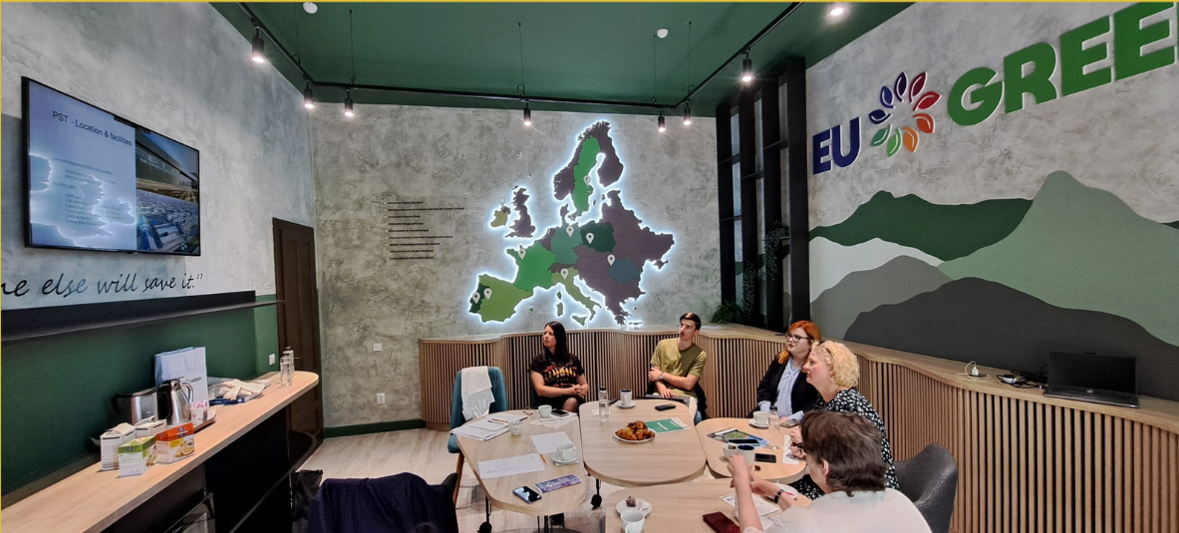
The University of Oradea opened the first EU GREEN Business Lounge. It became the inspiration for the network, showing that each lounge should be a welcoming space with its own identity rather than just another meeting room.
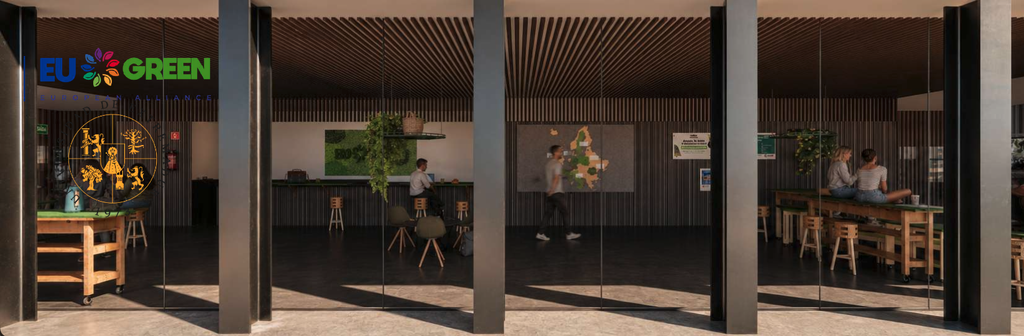
At Otto von Guericke University Magdeburg, the lounge is a stand-alone timber container with a patio, part of the new EU GREEN Innovation Hub. The University of Parma placed its lounge inside the university’s Food Incubator, next to start-ups and entrepreneurs. At the University of Gävle, a branded meeting room hosts hybrid sessions with partners and visits from external stakeholders.
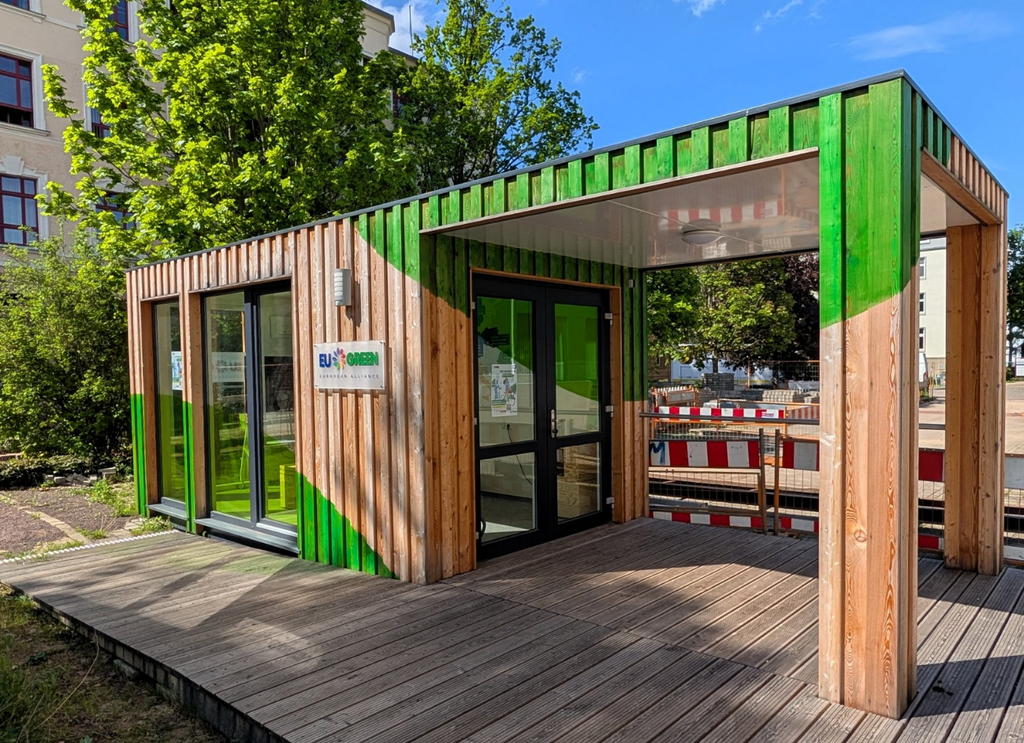
The University of Angers has taken the idea across two campuses. Its main lounge is the large meeting room of the international office on the Belle Beille campus, with a wall map of the alliance and the EU GREEN logo on a window facing the tram station, visible from the street. It will host meetings and workshops with stakeholders and events such as the Food Loop. Still in Angers, at the Saint Serge university library, eight working rooms are being renamed after the partner cities and regions, furnished with upcycled tables and decorated with images sent by each partner. Students can book them, and they also host alliance meetings, online classes and webinars that participants follow together in person.
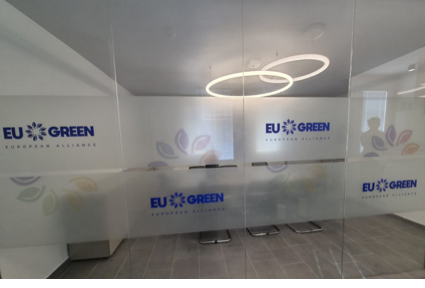
The EU GREEN Business Lounge within the Food Incubator of the University of Parma, Italy.
Other partner universities have developed spaces that reflect their own approaches to sustainability, innovation and collaboration, including initiatives showcasing circular-economy principles and facilities connecting university communities with regional partners.
Together, the nine lounges form a distributed network of physical spaces that reinforces the European dimension of EU GREEN while remaining firmly connected to the needs and opportunities of each region.
From infrastructure to lasting impact
The establishment of the Business Lounges represents an important legacy of EU GREEN’s first funding cycle. They provide the physical infrastructure and institutional connections needed to deepen cooperation with regional innovation ecosystems and strengthen the role of universities in addressing societal challenges.
As EU GREEN moves into its next stage of development, these spaces will support the Alliance’s ambition to expand knowledge transfer, foster responsible entrepreneurship, strengthen partnerships with regional stakeholders and promote the co-creation of solutions to sustainability challenges.
By bringing together academic knowledge, entrepreneurial initiative, public-sector engagement and civil society, the Business Lounges contribute to a more connected and collaborative European innovation ecosystem – one in which local expertise and regional needs can generate solutions with wider European and global relevance.
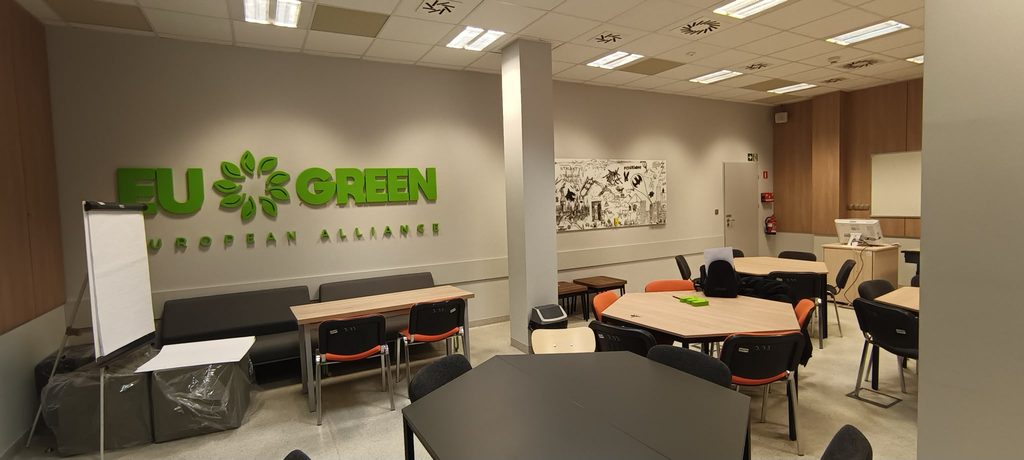
“The EU GREEN Business Lounges are a tangible invitation to engage and a clear demonstration of our partners’ commitment to positioning the Alliance as a bridge between universities and their regional ecosystems. They embody our ambition to think strategically and collaborate on a global scale, while remaining firmly rooted in a bottom-up approach, responding to the needs, challenges and opportunities of the regions in which we operate. By connecting local knowledge, expertise and stakeholders across our nine universities, we can turn regional relevance into collective European strength and create a meaningful impact beyond our borders.”
Raquel Pérez-Aloe Valverde, General Coordinator of EU GREEN
Within the framework of EU GREEN 2, a range of events and collaboration mechanisms have already been identified to strengthen engagement with external stakeholders. The Alliance also remains open to expressions of interest from organisations wishing to contribute to the promotion of European values and the sustainable development of the regions in which its partner universities are embedded.